Consolidate for Clarity: Fix Content Cannibalization to Win AI Traffic
Content cannibalization isn't a duplicate-content problem — it's a clarity problem, and clarity is what both search engines and LLMs now reward. This pillar covers how to diagnose cannibalized clusters, the Merge / Differentiate / Sunset triage for deciding what to do with each, a link-equity-preserving 301 strategy, and entity optimization for LLM citations.


Most SEO problems are visibility problems. Content cannibalization is a clarity problem — and clarity is exactly what both search engines and large language models reward now.
When two, five, or a dozen of your own pages compete for the same intent, you don't get more coverage. You get a diluted signal. Google splits ranking authority across pages that should have been one. And the newer layer of the search stack — AI Overviews, ChatGPT, Perplexity, Gemini — behaves even less forgivingly. These systems don't rank ten blue links; they synthesize an answer and surface a limited set of supporting links when the model decides it adds value. Ambiguity about which of your pages is the authority on a topic doesn't cost you a position or two. It costs you the citation entirely.
This is the strategic reframe for advanced teams: consolidation isn't cleanup. It's how you concentrate authority into assets strong enough to be quoted by a machine. Below is the full operating model — how to diagnose cannibalization, decide what to do with each competing cluster, execute the merge and redirect strategy without leaking equity, and harden the result so the problem doesn't regrow.
What Content Cannibalization Really Is (and Why It Hurts AI Visibility)
Content cannibalization happens when multiple pages on your site target the same search intent or keyword cluster, forcing search engines to choose between them — and often choosing badly, or splitting the vote so none of them win.
It is not duplicate content
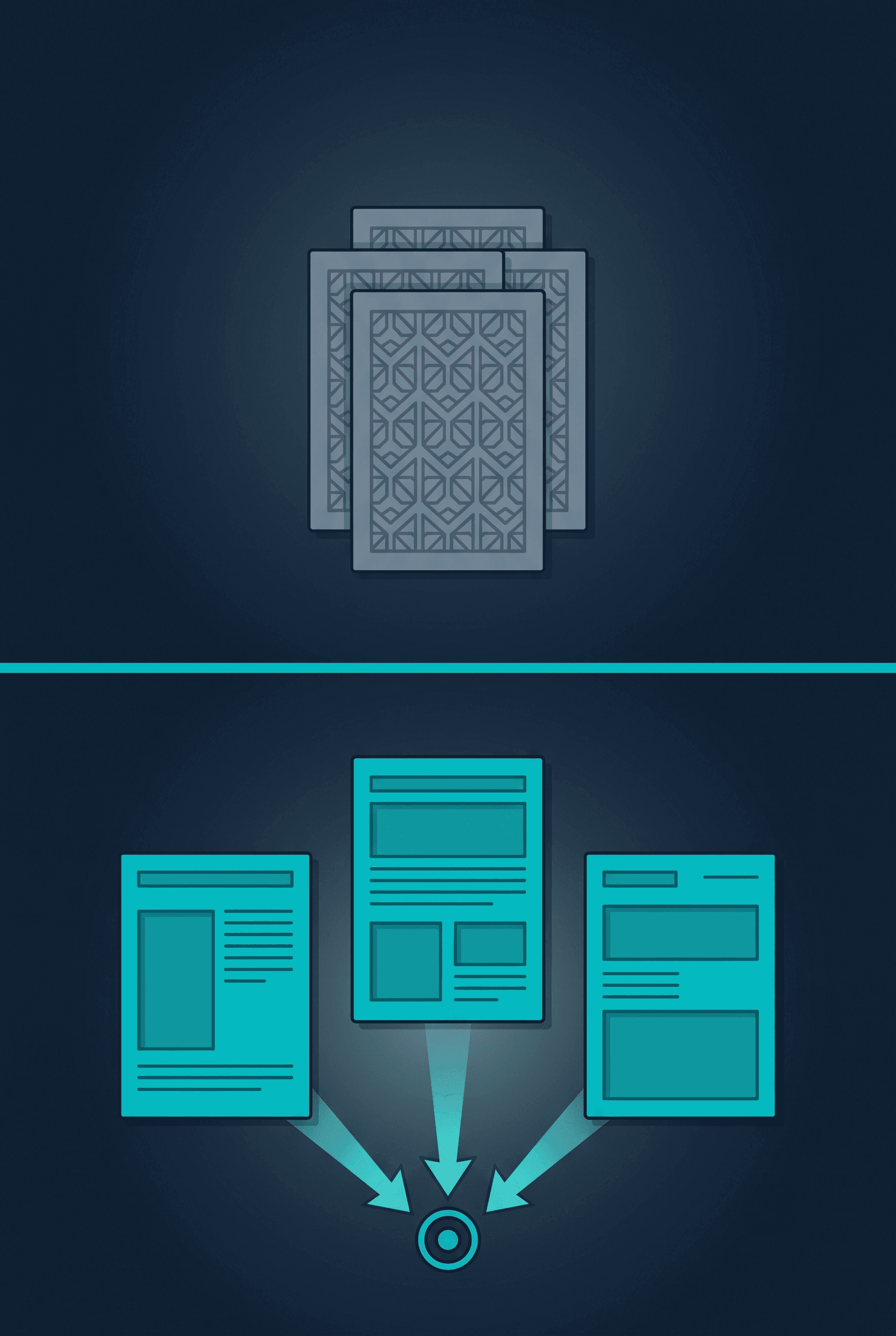
This distinction matters because the fix is different. Duplicate content SEO problems are about sameness of text — identical or near-identical copy across URLs. When Google finds near-identical pages, it clusters them and picks one canonical version to index and show, which is usually resolved with a canonical tag or a noindex. There's no penalty for the duplication itself — the cost is the lost control over which version represents you. Cannibalization is about sameness of intent. Two pages can be 90% unique in wording and still cannibalize each other because they answer the same question for the same searcher. You can't rel=canonical your way out of that when both pages have independent value; you have to make a strategic call about what each page is for.
Common causes
Cannibalization is rarely deliberate. It accumulates:
- Publishing velocity without governance. A blog that ships weekly for three years will re-cover its best topics. Nobody checks the archive first.
- Keyword-led content plans. Assigning one post per keyword variation ("speed to lead," "lead response time," "how fast to call a lead") when all three are the same intent produces three thin competitors instead of one strong page.
- Migrations and acquisitions. Merging two sites, or years of redesigns, leaves parallel pages that were never reconciled.
- Product and landing-page sprawl. Marketing spins up campaign pages that overlap with evergreen SEO pages.
Why competing pages confuse engines and LLMs
A search engine assigns relevance signals — links, engagement, topical association — to specific URLs. When those signals are spread across four pages targeting one intent, each page carries a fraction of the authority a single consolidated page would hold. You end up with four pages on page two instead of one page in the top three.
LLMs raise the stakes. Retrieval-augmented systems pull a limited set of passages to ground their answers in retrieved sources rather than model memory, then cite the ones they trust most. Consolidated, comprehensive, internally consistent pages are easier to retrieve and safer to cite. A fragmented topic — where your own pages contradict each other on definitions, recommendations, or framing — is a reason for a model to skip you and cite a competitor whose position is coherent. Fragmentation reads as low confidence. Machines route around it.
Signals cannibalization is hurting you
You don't need a tool to suspect it. You need it to confirm it. Watch for:
- Multiple URLs ranking for the same query, trading positions week to week (the classic "URL flip-flop" in rank tracking).
- A page's rankings that improve when you unpublish or deindex a sibling page.
- Impressions distributed across several URLs for one query in Google Search Console, with no single page consolidating clicks.
- Declining click-through rate on a query even as impressions hold — a symptom of a weaker page being surfaced instead of your best one.
What a cannibalized structure looks like
The recognizable pattern: a "hub" topic surrounded by satellite posts that each claim a slice of it, with no clear canonical resource and no intentional link hierarchy. "The Complete Guide to X" sitting beside "What Is X," "X Best Practices," and "How to Do X" — four pages, one intent, zero coordination. Each was reasonable in isolation. Together they compete.
How to Identify Cannibalized Content Across Your Website
Diagnosis before surgery. Consolidating the wrong pages destroys value as fast as leaving cannibalization in place.

Map URLs to intent, not keywords
Start by clustering your URLs by the job the searcher is trying to do, not by matching keyword strings. "Reduce churn," "lower customer churn," and "stop customers leaving" are one intent. Group every URL that plausibly serves each intent. The clusters with two or more URLs are your candidates.
Use Google Search Console to find competing pages
GSC is the fastest confirmation. In the Performance report, filter to a target query, then open the Pages tab. If a single query drives impressions to several of your URLs, you have measurable cannibalization. Note that GSC now attributes search metrics to the Google-selected canonical URL, so cross-check with your rank tracker to see the full set of competing URLs. Do the reverse too: take a high-value page, look at its top queries, and check whether other pages appear for those same queries. Export a few weeks of query-to-page data and sort for queries mapping to more than one URL — that list is your audit backlog, ranked by traffic at stake.
Identify overlapping keywords and entities
Beyond exact queries, look at entity overlap — the people, products, concepts, and relationships a page is about. Two pages covering the same core entities with the same framing are cannibals even if their keyword profiles look distinct. This entity lens is also what determines LLM citation entity signals later, so building it now does double duty.
Evaluate equity before you touch anything
For each URL in a competing cluster, pull four numbers before deciding its fate:
- Backlinks and referring domains — where external authority actually sits.
- Organic traffic — current and trended, so you don't kill a page that's climbing.
- Conversions or assisted conversions — the page's business value, which often diverges from its traffic.
- Rankings — which queries each page owns and how stably.
The page with the most traffic is frequently not the page with the most links or the most conversions. Consolidating without this data is how teams accidentally redirect their strongest backlink target into a page that never earned those links.
Prioritize
Rank clusters by traffic and revenue at stake, then by effort. Start where a merge concentrates meaningful authority with low execution risk. Leave the ambiguous, low-value clusters for last or leave them alone — not every overlap is worth a project.
The Triage: Merge, Differentiate, or Sunset

Here is where most consolidation advice fails: it assumes the answer is always "merge." It isn't. Merging pages that serve genuinely different intents destroys rankings for both. The decision needs a rule, not a reflex.
Run every competing cluster through two diagnostic questions. The answers route each cluster to one of three moves.
Question 1 — Same intent? Do these URLs serve the same underlying searcher job?
Question 2 — Independent equity? Does more than one URL hold meaningful links, rankings, or conversions on its own?
- Route each cluster by the answers. No to Question 1 → Differentiate: sharpen each page toward its distinct intent and repair the internal links and titles that blurred them.
- Yes to Question 1, then No to Question 2 → Sunset: one page holds the value, so 301-redirect the thin siblings into it.
- Yes to both → Merge: combine into one canonical resource, then 301 the rest into it.
Differentiate is the move operators skip most often, and it's frequently correct. If "email marketing" and "email deliverability" got tangled because of loose internal linking and overlapping titles, the fix isn't a merge — it's re-establishing two clear, distinct pages and repairing the signals that confused them.
Sunset applies when a cluster shares intent but only one page has earned anything. The thin variants aren't assets; they're noise. Redirect them and stop maintaining them.
Merge is reserved for the specific case where multiple pages share intent and each holds authority worth preserving — the scenario where a single consolidated page will be stronger than any of its parts and you have equity from several URLs to fold in.
The value of the triage is that it forces the equity check before the merge. It's the difference between concentrating authority and casually deleting it.
Content Consolidation Best Practices
Once a cluster routes to Merge, execution decides whether you gain authority or lose it.
Choose the canonical resource deliberately
The page that survives — the canonical resource everything else redirects into — should be chosen on a scorecard, not on which one you happen to like:
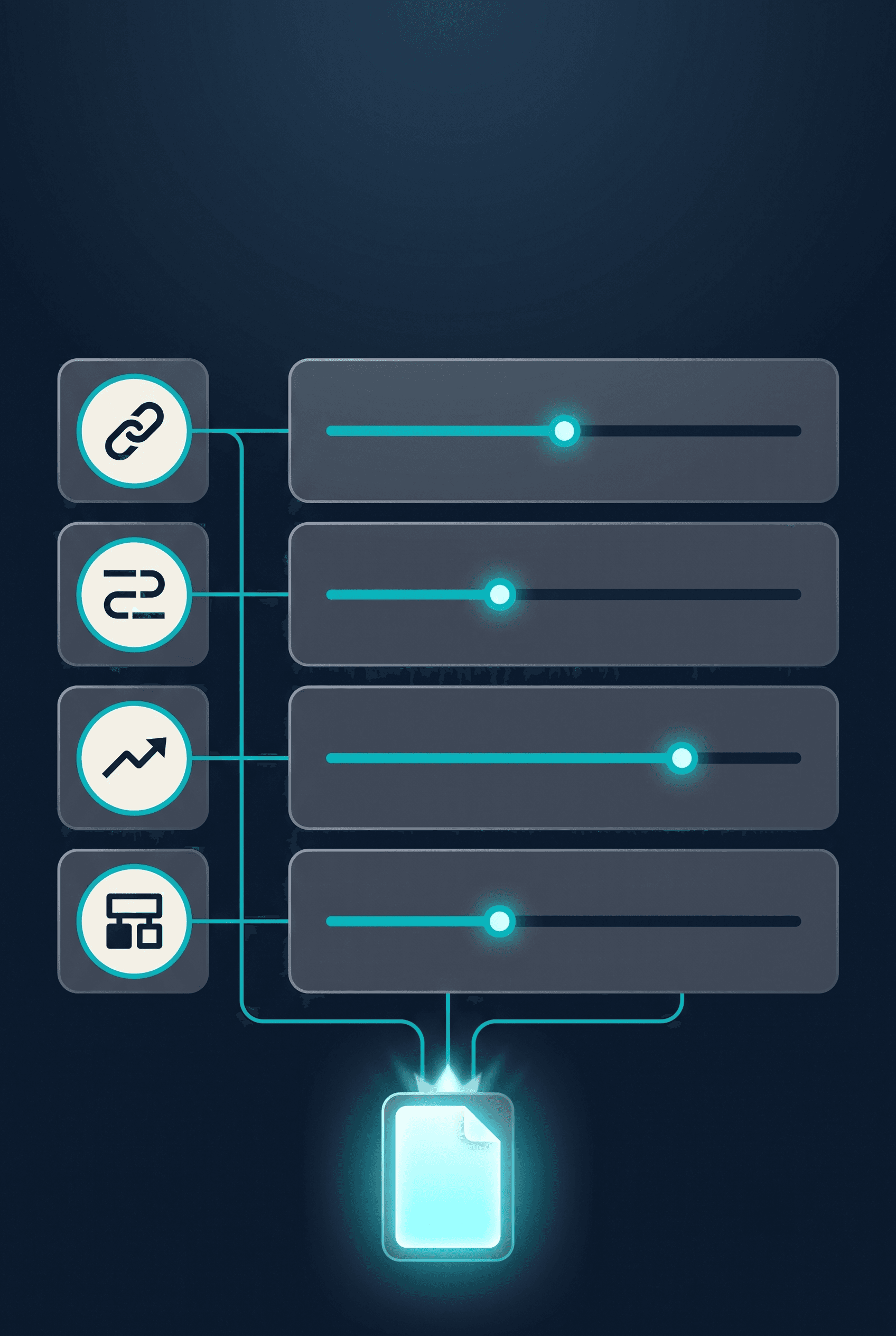
- Backlink profile — the page with the strongest, most relevant referring domains is the natural anchor, because its equity is hardest to rebuild.
- URL quality — a clean, descriptive, appropriately-placed URL is worth keeping; a dated or cluttered one is a reason to redirect into a better structure.
- Existing rankings and traffic — momentum is real; folding into a page that already ranks is lower-risk than promoting a fresh one.
- Structural fit — the page best positioned to become comprehensive pillar content, not just the current top performer.
When these conflict — strong links on an ugly URL — you can migrate to a better URL and 301 the old one, carrying the equity forward. Just don't do it casually; every redirect is a small risk.
Merge unique insights without flattening depth
The goal is a page that's more comprehensive than any single source, not a bloated stitch-up. Pull the genuinely unique argument, data, example, or angle from each page and integrate it into a coherent structure. Cut the redundancy — four introductions to the same concept become one. The test: a reader landing on the consolidated page should never feel they're missing something that lived on a page you retired.
Update headings, links, and structure
Rebuild the page's H2/H3 architecture around the full, merged scope so the hierarchy reflects a single authoritative resource. Then fix the internal links — every link that pointed at a now-redirected page should point directly at the canonical URL, not through the redirect. Update navigation, related-post modules, and in-body references.
Preserve topical authority
The risk in consolidation is stripping topical depth to reduce page count. Protect it. If a retired page ranked for a valuable long-tail subtopic, that subtopic needs a real home — a dedicated section — on the consolidated page, so you inherit the ranking rather than abandoning it.
Build pillars, not fragments
The strategic endpoint is comprehensive pillar content: one deep, authoritative page per major topic, supported by genuinely distinct sub-articles that link up to it. This is the structure both Google's topical-authority model and LLM retrieval reward — a clear center of gravity for each topic instead of a scattered field of near-duplicates.
Building an Effective 301 Redirect Strategy
Consolidation lives or dies on the redirect layer. A clean 301 strategy transfers the value; a sloppy one leaks it.

301 redirects vs. canonical tags
Use the right instrument:
- 301 redirect — the page is gone and its URL should permanently resolve to the canonical destination. This is the default for consolidation. Google treats a permanent server-side redirect as the way to move a URL for good; it passes ranking signals and removes the competing URL from the index.
- Canonical tag — both URLs need to keep existing (a printer version, a syndicated copy, a parameterized variant) but only one should rank. A canonical is a hint Google may override, not a directive it must follow. Never use a canonical where a 301 is warranted — you'll leave the cannibal live and merely suggest it shouldn't rank.
The failure mode: canonicalizing pages you should have redirected, so the "consolidated" siblings stay indexed and keep competing.
Map old URLs to destinations
Build an explicit redirect map — a spreadsheet pairing every retired URL with its single, specific destination. Google's own migration guidance is to map each old URL to its corresponding new page rather than dumping them somewhere generic. Redirect to the closest relevant page, never lazily to the homepage; a homepage redirect signals the original content had no specific successor, is often treated as a soft 404, and forfeits most of the topical equity.
Preserve link equity
A well-implemented permanent redirect does not bleed authority — Google has confirmed that 301 and other permanent redirects don't cause a loss in PageRank. What costs you equity is poor execution: redirect old URLs directly to their final destination in one step, and double-check the redirects carrying real backlinks.
Avoid chains and loops
A redirect chain (A → B → C) wastes crawl budget, slows users, and adds latency at every hop; Google advises redirecting to the final destination directly and keeping any chain short. A loop (A → B → A) breaks the page entirely. Before deployment, crawl the full redirect map to confirm every source resolves to its destination in a single hop with no cycles. When you consolidate a page that was already a redirect target, update the original redirect to point at the new final destination — don't stack a new hop on top.
Monitor after deployment
Redirects are not fire-and-forget. In the weeks after launch, watch server logs and GSC for redirect errors, soft 404s, and destinations returning the wrong status code. Confirm the consolidated pages are being crawled and indexed, and that the retired URLs drop out of the index. Re-crawl monthly for the first quarter to catch chains that creep in as other changes ship.
Entity Optimization for LLM Citations
Ranking and being cited are now separate games. Consolidation sets up the second one.

Why LLMs prefer consolidated sources
Language models ground answers by retrieving passages and citing sources they can trust. Google's AI features surface links and cite supporting pages alongside the generated answer, and a single comprehensive page that covers a topic coherently is easier to retrieve and safer to quote than a scatter of partial pages. Consolidation directly improves your odds of becoming the cited source, because it removes the internal contradiction and thin coverage that make a model choose someone else.
Strengthen entity associations
An entity is a distinct thing — a company, product, person, concept — and the relationships around it. To reinforce LLM citation entity signals, make the page's primary entity unambiguous: define it clearly, use consistent terminology throughout, and connect it explicitly to the related entities that define its context. Consolidation helps automatically — instead of one entity split weakly across five pages, you build one strong, well-connected entity on a single authoritative URL.
Improve semantic consistency
After a merge, audit for consistency. If the source pages defined a term three different ways or made conflicting recommendations, reconcile them into one clear position. Semantic consistency is what lets a model extract a confident, quotable claim. Contradiction is what makes it hedge — or cite elsewhere.
Use schema to reinforce relationships
Structured data (Article, Organization, FAQPage, and relevant sameAs and entity properties) makes the page's entities and relationships machine-legible. Google uses structured data to understand a page's content and the people, companies, and things it references. Schema doesn't manufacture authority, but it removes ambiguity about what the page is about and how its entities connect — a meaningful edge in retrieval and citation.
Create citation-worthy content
Machines cite specificity. Clear, self-contained claims, named frameworks, concrete examples, and unambiguous definitions are extractable; vague, hedged prose is not. Structure key insights as passages that stand on their own when lifted out of the page — because that is precisely how an LLM will use them.
Internal Linking After Consolidation
Redirects preserve external equity. Internal links decide how authority flows inside your site — and they're the lever most teams forget after a merge.

- Repoint every internal link to the canonical URL directly. Google's guidance is explicit: link internally to the canonical URL rather than a duplicate, which reinforces your preference and avoids an extra redirect hop.
- Remove outdated navigation paths. Menus, breadcrumbs, footer links, and related-content modules pointing at retired pages should be cleaned up, not left to resolve through redirects.
- Redistribute authority to priority content. Consolidation is the moment to intentionally funnel internal links toward your pillar pages, reinforcing the hierarchy you just built.
- Support clusters with contextual links. Genuinely distinct sub-articles should link up to the pillar with descriptive anchor text, and the pillar should link down to them. This is the topic-cluster structure that signals topical authority to engines and coherent scope to LLMs.
- Govern to prevent regrowth. Cannibalization comes back without a process. Add one gate to your editorial workflow: before any new page is briefed, check whether an existing page already owns that intent. If it does, the default is to strengthen the existing page, not publish a competitor. This single rule is worth more than any one-time cleanup.
Measuring SEO and AI Search Impact After Consolidation
Consolidation is a bet that concentrated authority outperforms distributed authority. Measure it deliberately, and give it time — Google notes you should expect temporary ranking fluctuation while it recrawls and reindexes after a significant change, so merges often dip before they climb.

Track ranking movement on the consolidated URL. Watch the canonical page's positions for the target cluster. The win condition is one page ranking higher and more stably than the several pages it replaced — not merely holding the old average.
Monitor organic traffic and CTR. Confirm the consolidated page captures at least the combined traffic of its predecessors, ideally more as it climbs. Rising CTR on target queries signals that a stronger, more relevant single page is now being surfaced in place of weaker competitors.
Measure AI Overview and LLM citation visibility. This is the newer, harder metric. Track whether your consolidated pages appear in AI Overviews and get cited by LLM search tools for your priority topics. Google surfaces this partly through the generative AI performance data in Search Console; supplement it with manual spot-checks against your top topics to establish a baseline you can trend.
Watch crawl efficiency and index coverage. In GSC, confirm retired URLs leave the index and the consolidated pages are crawled cleanly. Because Google crawls duplicate pages less frequently than the canonical, fewer thin competitors means crawl capacity concentrates on the pages that matter — a quiet but real benefit at scale.
Establish an ongoing workflow. Consolidation is a discipline, not a project. Run a cannibalization audit quarterly, keep the pre-publish intent check in your workflow permanently, and treat the redirect map as a living document. The teams that win AI traffic aren't the ones who cleaned up once — they're the ones who never let the fragmentation rebuild.
The Takeaway
Content cannibalization is what happens when volume outpaces intent. The fix isn't producing less — it's producing with clarity: one authoritative page per topic, competing signals consolidated into it, equity preserved through disciplined 301s, and entities made coherent enough for a machine to trust.
Run the Merge / Differentiate / Sunset triage across your competing clusters, protect equity through the choice of canonical and the redirect map, and govern the intent gate so the problem doesn't regrow. In a search landscape where an AI increasingly answers first and cites few, the site with the clearest, most consolidated authority on a topic is the one that gets quoted. Everyone else gets summarized out of the answer.