Marketing Attribution 101: Choose the Model That Fits
Most teams don't have a spending problem — they have a credit problem: revenue comes in, but no one can say what actually caused it. Here's how marketing attribution works, how the models really compare, and how to choose one that fits your business with the Fit Test, a four-question diagnostic.


Most marketing teams don't have a spending problem. They have a credit problem. They know the total came in — the leads, the revenue, the pipeline — but they can't say with confidence which channels, campaigns, or moments actually caused it. So budget gets allocated by whoever argues loudest, whichever dashboard is open, or whatever the ad platform claims for itself. Marketing attribution is the discipline that replaces that guesswork with a defensible answer to a single question: what actually moved this customer to buy?
Get it roughly right and every downstream decision improves — budget, creative, channel mix, the sales handoff. Get it wrong and you scale the wrong things confidently. This guide covers what attribution is, the models used to do it, how to choose one that fits your business, where it breaks, and how to measure it without drowning in tooling.
What Marketing Attribution Actually Is
Marketing attribution is the practice of assigning credit for a conversion to the marketing touchpoints that influenced it. A "touchpoint" is any interaction along the way: a paid search click, an email open, a webinar signup, a retargeting impression, a sales call. Attribution decides how much of the win each of those touches earned. Google's own definition frames an attribution model as a rule, set of rules, or algorithm that governs how credit is assigned across the touchpoints on a conversion path.

The reason this is hard — and the reason it's a discipline rather than a report — is that customers rarely convert in a straight line. Someone discovers you through a podcast ad, forgets about you, sees a LinkedIn post three weeks later, searches your brand name, clicks a Google ad, and finally converts from a nurture email. Six touches, one sale. Attribution is how you divide that one sale across those six touches so you can decide what to fund again.
Attribution vs. Analytics
These get conflated constantly, and the confusion is expensive. Analytics tells you what happened — sessions, bounce rate, conversions by channel. Attribution tells you what deserves credit for it. Analytics can report that your paid search channel produced 200 conversions last month. Attribution is what determines whether paid search earned those 200 conversions or merely closed deals that other channels opened. Analytics is the scoreboard. Attribution is the assist chart.
If you only look at analytics, you'll systematically overfund whatever channel tends to appear last in the journey — usually branded search or direct — because that's where the conversion is recorded, not where it was created.
How attribution works, in practice
Every attribution system does three things: it identifies a user across touchpoints (via cookies, logins, device IDs, or CRM records), it records the sequence of touches, and it applies a rule to split credit across them. That rule is the attribution model, and choosing it is the decision that matters most. Everything else is plumbing.
Why Attribution Is Worth the Effort
Attribution isn't a reporting nicety. It's the input to four decisions that determine whether marketing compounds or leaks.

Budget allocation. Without attribution, budget follows the last click, which means top-of-funnel channels — the ones that create demand — get starved because they rarely get the closing credit. Attribution lets you fund the channels that start winning journeys, not just the ones that finish them.
Channel and campaign optimization. When you can see which touches actually advance customers, you can double down on the sequences that work and kill the ones that only look busy. A campaign with a great click-through rate that never appears in a winning path is a campaign to cut.
Marketing–sales alignment. In longer cycles, attribution is the shared language that ends the "marketing sent us garbage leads / sales fumbled good ones" argument. Tools built for this, like HubSpot's multi-touch revenue attribution, trace revenue back across every touchpoint tied to a closed deal — giving both teams evidence instead of opinions.
Data-driven decisions at the right altitude. Attribution turns "we think Instagram is working" into "Instagram appears as the first touch in a large share of closed deals but almost never the last" — which is a completely different, and far more useful, statement.
The value scales with complexity. A local business running one channel barely needs formal attribution — the answer is obvious. A startup running five channels into a two-week sales cycle needs it to avoid misreading noise. A mid-market company with a multi-month, multi-stakeholder buying journey needs it to survive quarterly budget reviews. The more touchpoints and the longer the cycle, the more attribution stops being optional.
Marketing Attribution Models
An attribution model is just the credit-splitting rule. They fall into three families, and understanding the families matters more than memorizing all nine variants.

Single-touch models
These give 100% of the credit to one touchpoint.
- First-touch credits the interaction that started the journey. It answers "what creates demand?" and is biased toward top-of-funnel discovery.
- Last-touch credits the final interaction before conversion. It answers "what closes?" and is biased toward bottom-of-funnel and branded terms.
Single-touch models are simple, cheap, and honest about being blunt instruments. Their trade-off is obvious: real journeys have more than one touch, so any single-touch model is deliberately ignoring most of the story. They're defensible only when your cycle is genuinely short or when you specifically want to isolate one end of the funnel.
Multi-touch models
These distribute credit across several touches according to a fixed rule.
- Linear splits credit evenly across every touch. Democratic, but it treats a throwaway retargeting impression the same as the demo that closed the deal.
- Time-decay gives more credit to touches closer to the conversion. Reasonable for shorter cycles where recency correlates with influence; it structurally underweights early demand creation.
- U-shaped (position-based) loads credit onto the first and last touches (commonly 40% each) and spreads the rest across the middle. A sensible default for teams that care about both demand creation and closing.
- W-shaped does the same but adds a third weighted anchor — usually lead creation or opportunity creation — making it well-suited to B2B funnels with defined stages.
- Full-path extends W-shaped through to the closed deal, weighting first touch, lead creation, opportunity creation, and close. Built for long, stage-heavy sales cycles.
The trade-off across all of these: fixed-rule multi-touch models are more realistic than single-touch, but the weightings are still assumptions you're imposing, not truths you've discovered.
Data-driven attribution
Instead of you assigning the weights, an algorithm assigns them by analyzing which touch patterns actually correlate with conversion across your data — evaluating both converting and non-converting paths to learn each touchpoint's real contribution. It's the most sophisticated approach and, in theory, the most accurate, because the weights come from your customers' real behavior rather than a rule of thumb.
The catch, and it's a big one: data-driven attribution needs volume and clean data to work. With thin conversion data or gaps in tracking, the algorithm is confidently modeling noise. This is the single most over-reached-for model — teams adopt it because it sounds rigorous, then feed it data that can't support it. The industry is moving this direction regardless: in 2023 Google removed the fixed multi-touch models from GA4 entirely — first-click, linear, time-decay, and position-based — leaving only data-driven and last-click. That consolidation is a signal, not a mandate: it doesn't mean data-driven fits every business.
Misconception to kill: there is no "most accurate" attribution model in the abstract. A model is accurate only relative to your cycle length, touch density, and data quality. Copying whatever's trendy — usually data-driven right now — without checking fit is how teams generate precise-looking numbers that are quietly wrong.
The Fit Test: Choosing a Model That Matches Your Business
Model selection is where most attribution efforts go sideways, because teams pick a model based on sophistication signaling rather than fit. Here's a decision rule that keeps you honest. Run your business through four questions, in order.

1. How long is your sales cycle?
If it's days, recency dominates and a single-touch or time-decay model is defensible. If it's weeks to months, single-touch will actively mislead you and you need multi-touch. Why it matters: long cycles accumulate touches that single-touch models pretend don't exist.
2. How many meaningful touches occur before conversion?
Few touches (one to three) means multi-touch modeling adds complexity without insight — the journey is legible without it. Many touches means you need distribution, and probably a staged model (W-shaped or full-path) that anchors on funnel milestones. Why it matters: modeling precision you can't act on is cost without return.
3. Can you actually see the touches?
This is the question teams skip and shouldn't. If large parts of your journey are dark — offline conversations, un-tracked channels, cross-device gaps — then a sophisticated model is decorating incomplete data. Fix visibility before you upgrade the model. Why it matters: a fancy model on partial data produces false confidence, which is worse than an honest blunt model.
4. What decision will this actually change?
If the answer is "how we split budget across the top of the funnel," you need a model that credits early touches. If it's "which closing tactic to scale," you need one that credits late touches. If nothing about your spending or strategy will change based on the output, you're overinvesting in attribution. Why it matters: attribution exists to change decisions. Model precision beyond your decision resolution is vanity.
The Fit Test resolves to a simple pattern: short cycle, few touches, clean data, tactical decisions → single-touch or time-decay. Long cycle, many touches, staged funnel → W-shaped or full-path. High volume, clean data, and the maturity to trust a black box → data-driven. Start at the lowest model that fits and earn your way up. You can always add sophistication; you can't retroactively add trust to a number your team already learned to distrust.
Where Attribution Breaks
Even a well-chosen model degrades in the real world. Know the failure points before they surprise you.

Cross-device and cross-platform gaps. A customer researches on their phone and buys on their laptop. Without a login or a persistent identifier tying those sessions together, your model sees two strangers instead of one journey. This is one of the largest sources of silent attribution error.
The cookie picture is messier than "cookies are dying." The popular narrative oversimplifies. Google reversed its plan to deprecate third-party cookies in Chrome, so they persist there under user control — but Safari and Firefox have blocked them by default for years, which means a large share of the web is already effectively cookieless. Layer on privacy regulation like GDPR and CCPA, and the practical effect is the same: more of the journey goes dark, unevenly, across browsers. The durable response isn't reconstructing the old cookie-based visibility — it's shifting toward first-party data: logins, CRM records, and server-side tracking you actually own.
Offline touches. Trade shows, sales calls, word of mouth, and podcast ads influence buyers but often leave no digital trace. If a meaningful share of your influence is offline, no online model captures it, and you'll structurally undervalue those channels.
Data silos. Your ad platforms, analytics, email tool, and CRM each hold a fragment of the journey and rarely agree. Attribution that runs on one silo inherits that silo's blind spots. This is why the tooling conversation is really an integration conversation.
The double-counting trap. Every ad platform claims conversions in its own dashboard using last-click logic. Add up what Google, Meta, and your other platforms each claim, and you'll "prove" more conversions than you actually had. Never build a budget from platform-reported numbers summed across platforms — that's the most common and most expensive attribution mistake there is.
How to Measure Attribution
Measurement is where attribution becomes operational. The essentials, in order of leverage:

Standardize campaign tracking with UTMs first. Attribution in marketing analytics is only as good as the tags feeding it. Every paid and campaign link needs consistent UTM parameters — source, medium, campaign, and where relevant content and term. Google is explicit that a standardized UTM strategy is what prevents data fragmentation and keeps traffic from being miscategorized in your reports. Inconsistent tagging (Facebook vs. facebook vs. FB) quietly corrupts every downstream number. This is unglamorous and it is the highest-ROI hour you'll spend on attribution.
Track the conversions that matter, not everything. Define the specific actions that represent real progress — qualified lead, opportunity created, purchase — and instrument those. Tracking every micro-interaction dilutes the signal.
Watch the right metrics. Beyond raw conversions, the useful attribution metrics are cost per acquisition by model, revenue attributed by channel, and assisted conversions (how often a channel appears in winning paths without closing them). That last one is what rescues top-of-funnel channels from being cut on last-click logic.
Build the dashboard around decisions, not vanity. An attribution dashboard should answer "what do we fund next month" at a glance. If a chart doesn't change a decision, it doesn't belong on the dashboard.
Attribution Tools
Tooling matters less than most teams think and later than they think. Fit and clean tracking come first; software only executes the model you've chosen. Broadly, the options cluster into four categories:

- Native platform attribution — Google Analytics and Google Ads attribution reporting. Free, accessible, and fine for early-stage teams, but each platform is biased toward crediting itself.
- CRM and marketing-platform attribution — HubSpot and similar. Strong for B2B because they tie touches to the actual pipeline and revenue, not just clicks.
- Enterprise analytics suites — Adobe Analytics and comparable. Powerful and configurable, with the cost and complexity to match.
- Specialist attribution platforms — Triple Whale and Northbeam (ecommerce-leaning), and Dreamdata (B2B-leaning). These exist to solve the multi-platform, multi-touch problem that native tools can't, and earn their price only once your journey complexity justifies it.
When comparing software, weigh it on three things: does it integrate with the data sources where your journey actually lives, does it support the model your Fit Test pointed to, and can your team operate it without a dedicated analyst. A tool you can't run is worse than a simpler one you can.
Best Practices
The habits that separate attribution that compounds from attribution that gets abandoned:
- Define conversion goals before you touch a model. You can't attribute credit for an outcome you haven't specified.
- Standardize tracking and enforce it. A naming convention nobody follows is worse than none.
- Integrate your data sources. Attribution across silos is attribution across blind spots. Unifying data does more for accuracy than any model upgrade.
- Audit regularly. Tracking breaks silently — a redirect drops a UTM, a form stops firing a tag. Schedule an attribution audit or you'll trust broken data for months.
- Test more than one model. View your journeys through two lenses — say, first-touch and W-shaped — and pay attention to where they disagree. The disagreement is where the insight lives.
Pair attribution with incrementality — and don't confuse them
Attribution answers "which touches were present in conversions." Incrementality answers "which touches actually caused conversions that wouldn't have happened otherwise." Google itself defines incrementality as knowing exactly what happens because of your marketing, and what would not have happened otherwise — measured with a randomized holdout, where one group sees the campaign and a matched group doesn't. The gap between the two questions is where budget quietly gets wasted.
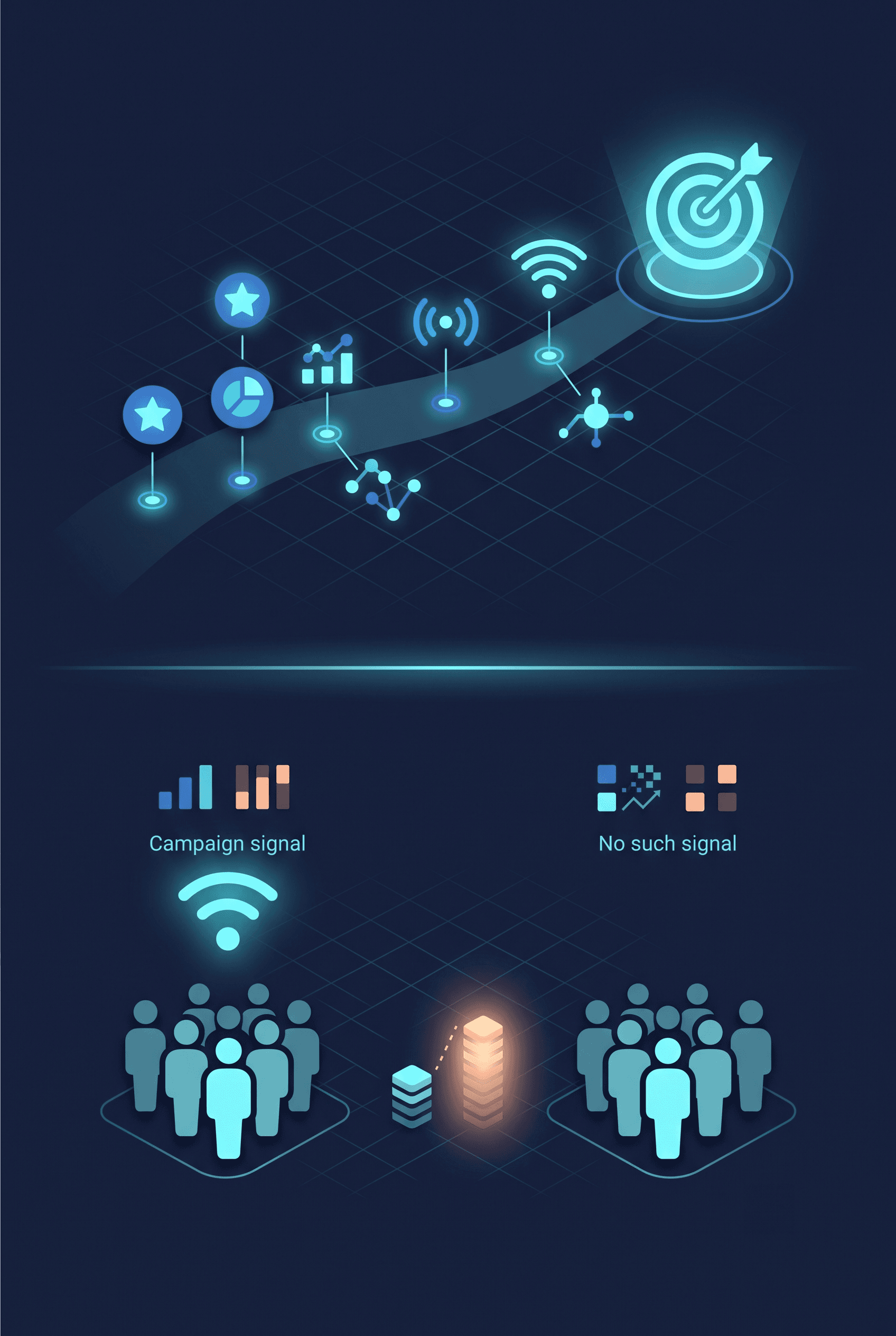
The classic example: a brand credits its retargeting ads with a large share of conversions because those ads appear right before purchase. Attribution loves them. But an incrementality test — showing the ads to one group, withholding them from a matched group — often reveals those customers were going to convert regardless. The ads were taking credit for demand they didn't create. Attribution tells you what to investigate; incrementality testing tells you what's real. Use attribution for continuous steering and periodic incrementality tests to validate that your highest-credited channels are actually pulling their weight.
The Bottom Line
Marketing attribution isn't about achieving perfect, courtroom-grade certainty on every dollar — that certainty doesn't exist, and chasing it is its own kind of waste. It's about building a defensible, consistent, decision-grade view of what's working so you stop funding the wrong things confidently.
Start with the Fit Test. Match the model to your cycle, your touch density, your data quality, and the decisions you'll actually make. Get your tracking clean before you get your tooling fancy. Treat every attribution number as a well-reasoned estimate, not a fact — and validate the estimates that carry real budget with incrementality. Do that, and attribution stops being a reporting chore and becomes what it's supposed to be: the mechanism that makes your marketing spend get smarter every quarter instead of just bigger.
- Marketing Attribution
- Attribution Models
- Multi-Touch Attribution
- Data-Driven Attribution
- Marketing Measurement
- Incrementality
- Marketing Analytics